Informations about kidney disease and diabetes, Any question Email me: kidneyfailurecn@hotmail.com
Saturday, March 9, 2013
Preparing for Hemodialysis
When Chronic Kidney Disease develops to Stage IV (which is also known as End-stage Renal Failure) along with GFR﹤30 cc/min, dialysis turn to an inevitable choice. Dialysis can be mainly divided into hemodialysis and peritoneal dialysis. The key to a successful hemodialysis depends upon awareness and preparation. So what should we do before we perform hemodialysis?
a) Certain tests should be run before receiving hemodialysis
Those tests include heart check, vaccination status, dialysis access and some others. By detecting the heart condition in advance, the doctor could recommend you a better dialysis type, for example, those with diabetes or high blood pressure may suffer from a weak heart than others, to those kinds of people, hemodialysis is their first choice. Usually, the doctor will suggest you a peritoneal dialysis instead of the former one.
b) Control your blood pressure
High blood pressure itself can damage kidney function. Taking good control of your blood pressure contributes to your kidneys especially during Chronic Kidney Failure or ESRD. Having a good control over your high blood pressure would effectively slow down the progression of Chronic Kidney Failure as well as reduce the incidence of cardiovascular complications. Besides, ultrafiltration and sodium discharge of dialysis have a confirming function of depressing high blood pressure.
c) Psychoneself
Doctor has the responsibility to help patients get ready for hemodialysis. However, mental preparation in advance really matters, because it can not only help patients deal with the fact that he/she needs hemodialysis without delay, but also spare time getting down to vascular access.
d) Dialyser examination in advance is necessary
To check whether the package rupture or not, and whether dialyiser disrepair or not, instruction of the new dialyser should be read before usage. Realize about disinfection methods, material of membrane, pre-congestion amount, ultrafiltration rate, maximum tolerant pressure, clearance rate of small molecules and moderate molecular and remaining blood volume etc.
Friday, March 8, 2013
Signs and Symptoms of CKD
CKD (Chronic Kidney Disease) or Chronic Renal Insufficiency describes a progressive loss of the kidney function over time. Chronic Kidney Disease is classified as five major stages in line with GFR.
In stage one and two, one’s kidney function is normal or mild damaged, no obvious signs or symptoms form. Only the GFR (glomerular filtration rate) reduces. In stage 1, GFR is no less than 90% while the GFR reports as 60 to 89% in stage 2. It is 30-59% as the medical condition progresses to stage 3. Additionally, signs and symptoms occur accordingly. Just for your information, the symptoms won’t appear until no more than 50% of kidney function is impaired. More serious and significant signs and symptoms show up when GFR declines to 15-29% or even less than 15%. This is the last two stages of CKD, namely, Chronic Renal Failure and End-stage Renal Failure.
Common signs and symptoms of CKD:
Due to the kidney function has not been affected yet in the first two stages, no or few physical symptoms appear. Serum creatinie may begin to elevate or stay normal during this period and indicates that half of your kidney function is lost.
In stage 3 to 4, the serum creatinine probably increases as a result of kidney injury. Besides, fatigue and weakness occur, puffiness is obvious in hands, feet, ankles and eyelids. Usually, kidney disease patients experience back pain or flank pain from time to time. The changes in urine may be the most common symptom of kidney injury. It can be increased urine output, the changes in color, and the frequency etc. in some cases of kidney disease, foamy urine develops.
Stage 5 of Chronic Kidney Insufficiency, also called End-stage Renal Failure (ESRF), is the most serious illness condition of kidney disease. The medical condition has no chance to reverse as progresses to ESRF. Dialysis and kidney transplant become the few left options for ESRF patients. Signs and symptoms of ESRF are fatigue, headache, muscle cramps, nausea, vomiting, lower metal sharpness, night-time urination, itching, decreased sex drive, high blood pressure, shortness of breath, chest pain, loss of appetite etc.
Thursday, March 7, 2013
Type 1 Diabetes Symptoms in Children
Type 1 Diabetes (insulin-dependent diabetes, juvenile diabetes) results when the pancreas loses its ability to make the hormone insulin. In children with Type 1 diabetes, their own immune system attacks and destroys the cells in the pancreas that produce insulin. Once those cells are destroyed, they won’t ever make insulin again. The following are some common symptoms of children with Type 1 Diabetes.
◆ Frequent urination
As excessive glucose builds up in the bloodstream of children, the kidneys respond to high levels of blood glucose by flushing out it in urine. A child with diabetes needs to urinate more frequently and in larger volumes.
◆ Excessive thirst
Since the child is losing so much fluid from peeing so much, he or she becomes excessive thirst, who drinks a lot in order to keep a normal level of water and avoid being dehydrated.
◆ Weight loss
Even though kids who develop Type 1 Diabetes may eat more than usual to relieve hunger, he may lose weight-rapidly at times, because the body breaks down muscle and stored fat so as to provide fuel to the hungry cells.
◆ Fatigue
The muscles and cells are deprived of glucose, so the child may become tired and lethargic.
◆ Bedwetting
In some cases, this is the first sign of diabetes in a child who has been dry at night.
Besides, a vaginal yeast infection may also be suspected as a sign of diabetes if a girl hasn’t started puberty yet.
Type 1 Diabetes in children can be very dangerous simply due to they cannot explain fully what is happening in their body. If the above symptoms aren’t detected and treated early, chemicals called ketones may build up in the child’s blood, causing stomach pain, nausea, vomiting, fruity-smelling breath, breathing problems, and even loss of consciousness.
Immunotherapy is the most advanced therapy for Type 1 Diabetes, and you can choose this best treatment for your child.
Wednesday, March 6, 2013
What is Wrong If I Have an Elevated Creatinine Level
Creatinine refers to a chemical waste product in the blood that passes through the kidneys to be filtered and excrete in urine. The chemical waste is a by-product of normal muscle contractions. People who have chronic kidney disease (CKD) may suffer from high creatinine. So how does this occur?
CKD appear when the kidneys becomes damaged and are no longer able to properly filter waste and extra fluid out of the blood through urine. You will develop raised creatinine levels when the glomerular filtration mechanism becomes gradually damaged.
The higher the level is, the more damage there may be to the kidneys. A level greater than 1.50 mg/dl for male and 1.10 mg/dl for female is abnormal and may indicate kidney disease. For adult patients, dialysis is recommended when the number reach 10.0 mg/dl; for babies with chronic kidney disease, dialysis is recommended when the level is 2.0 mg/dl.
Symptoms of raised creatinine level
Symptoms are the same as Renal Failure symptoms. In some cases, people find out they have kidney failure without feeling any discomforts at all. Yet some persons may experience the following:
▪ Weakness, or fatigue
▪ Confusion
▪ Shortness of breath
▪ Dehydration
As the kidneys becomes increasing unable to cope, your disease will deteriorate. So it is necessary to find an effective treatment to repair the damaged filtration membrane and restore the kidney function so as to avoid dialysis.
Tuesday, March 5, 2013
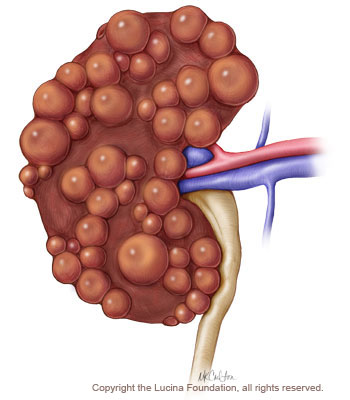
Why PKD Cause Renal Failure
PKD (Polycystic Kidney Disease) can’t be cured, it just can be controlled and treated to stop it progression to Renal Failure.
How PKD lead to Renal Failure?
The cysts in kidneys are relatively small. Symptoms normally appear after the age of 30. Before the onset developing, the disease progresses in a rather slow speed. However, PKD progresses over time not only in size, but also in number. Increasing cysts grow and pressure the surrounding tissues or organs, causing serious problems. The kidney function would deteriorate progressively and finally lead to Renal Failure or even End-stage Renal Failure. During the process, one’s kidney function declines sharply. PKD patients have to receive dialysis or kidney transplantation in the end.
Since we have already known the relationship of PKD and Renal Failure, how to prevent it from happening?
Early diagnosis
If you have a family history, you should keep an eye open for your condition. regular check-ups benefits. Ultrasonic, CT, MRI and other tests contribute to the diagnosis of the disease. Serum creatinine along with urea nitrogen is the two common indexes signal the kidney function.
Take good care of yourself in daily life
Diet and daily proper daily exercises are definitely good for the physical condition with PKD. (Wanna know the inducing factors of Polycystic Renal Disease? Consult our doctor on line!)
Timely treatment
The current treatments are kidney replacements, i.e. dialysis and kidney transplantation.
Our featured therapies such as Immunotherapy therapy and Micro-Chinese Medicine Osmotherapy
The progression of PKD different from person to person, about one in three people with ADPKD get to the age of 70 without any serious Renal Failrue.
How to Reduce High Creatinine Levels Effectively
Creatinine is a substance produced by muscular activity when creatine phosphate is broken down. As a waste product, it is filtered from the blood by the kidneys, and so high creatinine levels in the blood can often indicate the kidney malfunction.
Normal range of serum creatinine
A creatinine level is the measurement of the amount of creatinine in a sample of blood. Normal range levels for male are 0.6~1.2ml/dL. For females, the normal range is between 0.5~1.1mg/dL.
Serum creatinine is an important blood test in diagnosing kidney disease, especially when you have elevated high creatinine in the blood and low creatinine in the urine at the same time.
What causes high creatinine levels in kidney disease?
A change in kidney function is the most common cause of high creatinine levels in the blood. Our kidneys are composed of approximately one million filters for each kidney, called nephrons. One nephron contains a glomerular-and tubule unit. Most creatinine is normally excreted out along these filtering units, so we can maintain the low blood creatinine levels.
In kidney disease, the renal nephrons are damaged, so the filtrating units fail to expel the creatinine in the blood stream adequately, resulting in elevated creatinine levels. Diabetes and chronic high blood pressure are common causes of diminished kidney function.
How to reduce high creatinine levels effectively?
We have found that the causes of high creatinine levels in kidney disease are due to damages to the nephrons, so in order to lower it effectively, we must repair the impaired nephrons and recover the kidney function.
Here, we'd like to introduce a natural remedy which can help you reduce high creatinine levels, known as Micro-Chinese Medicine Osmotherapy. This natural treatment combines traditional Chinese medicine (TCM) with modern medical technology, and have been clinically used in our hospital to treat high creatinine and kidney disease successfully.
Monday, March 4, 2013
Why does Drop in Osmotic Pressure Cause Swelling in Nephrotic Syndrome
There are tiny blood vessels in the kidneys that filter waste and excess water from the blood stream. When these filters are damaged, a person will get Nephrotic Syndrome. The most common early symptom of this disorder, in both children and adults, is swelling in the tissues around the eyes or in the ankles or feet due to drop in osmotic pressure. The following gives detailed introduction.
Colloid Osmotic Pressure
It can also be referred to as oncotic pressure, which is a measurement of pressure exerted within the cardiovascular system by proteins found in blood plasma. Maintaining the proper levels osmotic pressure ensures that the body tissues maintain the proper levels of liquid and that too much liquid doesn't escape from the capillaries.
Normally, colloid osmotic pressure tends to cause fluid to be drawn into the capillaries. Variations in this pressure can lead to build up of fluid in the tissues, a condition called edema, or swelling.
Swelling due to Drop of Osmotic Pressure in NS
Individuals with NS suffer from large quantity of Urine Protein. Massive proteins will get released into the urine, leading to reduced amount of plasma colloid osmotic pressure. If this happens, the normal exchange of body fluid is disturbed and cannot keep balance any more. Water in blood vessels will transfer toward tissue fluid, resulting in swelling.
Besides, another cause of edema in NS is also associated with low blood protein concentration.
Water in the blood transfers toward interstitial tissue, leading to low effective blood volume. This in turn gives rise to the production of Anti-diuretic Hormone (ADH). Renal tubules will reabsorb more water and sodium, resulting in more water retention. This condition will aggravate the swelling in NS.
Subscribe to:
Posts (Atom)